Who Approved This?! A Deep Dive Into Unhinged Marketing
Explore what happens when chaos becomes a content strategy.
Contents

Some brand posts feel like they slipped past legal. The best ones make you glad they did. That’s the appeal of unhinged marketing. It feels loose, strange, and a little risky, but the smartest brands aren’t posting chaos for chaos’ sake. They know exactly how far they can push before the joke stops working.
Unhinged marketing works best when the chaos is recognizable as the brand, not borrowed from a trend. That’s why some brands can post as if they’re one comment away from a crisis-management moment and still earn trust. Their audience understands the joke. The product still makes sense, and the tone feels intentional.
The brands that make it work know their audience, understand the platform, and have enough confidence in their brand voice to loosen the grip without losing the plot.
Unhinged marketing sits somewhere between humorous marketing, outrageous marketing, and internet-native brand storytelling. The best versions feel sharp and self-aware. The worst versions feel like a brand discovered popular memes three weeks too late.
The risk comes when brands mistake unhinged for unrestricted. Wacky can be strategic. Chaotic can be memorable. But when a brand chases attention without a clear point of view, it can move from funny to forced fast. So, what is unhinged marketing, why are some brands using it, and should your brand try it?
Key Takeaways:
- Unhinged marketing works when it still feels like the brand.
- Cringe marketing happens when the joke feels forced or out of touch.
- The best examples are repeatable, recognizable, and strategic.
- Not every brand needs to go fully unhinged to stand out.
- Measure sentiment, shares, saves, traffic, and conversions, not views alone.
What Is Unhinged Marketing Exactly?
Unhinged marketing is a social-first content style that uses absurdity, blunt humor, self-awareness, popular memes, internet language, and unexpected creative choices to earn attention.
It can look like:
- A brand mascot acting like a main character.
- A product account posting surreal, low-fi videos.
- A brand openly making fun of itself.
- Content that feels intentionally messy, strange, or hyper-specific.
Unhinged marketing is controlled unpredictability. The content may feel chaotic, but the strategy behind it should be clear. A good unhinged post feels like the brand’s inside joke with its audience. A bad one feels like a brand wearing someone else’s clothing.
Think of unhinged marketing as a sharper, riskier branch of a broader content marketing strategy. It works when the brand voice is already clear enough to stretch. Without that foundation, the content can feel random instead of recognizable.
The best unhinged marketing still answers the basic question every piece of brand content should answer: Why should this come from us?

Unhinged Marketing vs. Cringe Marketing vs. Chaos Marketing
Unhinged marketing, cringe marketing, and chaos marketing often get lumped together, but they’re not interchangeable.
Unhinged marketing is intentionally strange, funny, blunt, or absurd in a way that fits the brand. It has a point of view. The audience understands why the brand is acting this way.
Cringe marketing is content that feels forced, awkward, or out of touch. Sometimes it tries too hard to sound young. Sometimes it overuses memes. Sometimes the brand enters a conversation it doesn’t understand. That’s how brands end up in millennial cringe territory, using language their audience has already retired.
Chaos marketing is broader. It’s a strategy built around unpredictability, speed, and cultural participation. It may include unhinged marketing, but it can also include stunts, reactive posts, creator collabs, unexpected launches, and platform-native experiments.
The simplest way to separate them is this:
- Unhinged marketing feels risky, but right.
- Cringe marketing feels risky, and wrong.
- Chaos marketing is the operating system that allows either one to happen.
Why Brands Are Going Unhinged
Brands are going unhinged because the old rules of brand behavior don’t always match how people consume content now. Social moves fast, attention is limited, and audiences can tell when a post was sanded down by too many approvals.
Unhinged marketing can make a brand feel faster, funnier, and more culturally aware. But the strategy only works when the humor has a reason to exist. The best examples aren’t random. They’re built around audience behavior, platform fluency, and a clear sense of what the brand can credibly say.
Attention and shareability
Social platforms reward content that earns a reaction. A like is fine. A share is better. A comment thread is gold.
Unhinged content is built for reaction because it gives people something to talk about. It surprises them. It interrupts pattern recognition. It makes the viewer think, “Who approved this?” and then send it to someone else.
Some of the funniest brands on social throw out the idea of how a brand should act. Their goal instead is to be memorable enough that people quote the post, tag a friend, or bring the brand into a conversation it didn’t have to pay to enter.
That matters in a feed where brands are competing with creators, friends, celebrities, memes, news, and niche internet drama at the same time. Unhinged marketing gives brands a chance to show up as entertainment, instead of interruption.
Polished brand content feels easier to ignore
Audiences have learned how to spot brand content instantly. Clean product shots. Safe captions. Perfect lighting. A call to action in the first three seconds.
There is a place for polished content. It builds trust, explains value, and supports conversion. But on social, polish can also become invisible.
This is one reason creator content, user-generated content, and low-fi formats keep showing up in marketing conversations. People want content that feels natural to the platform, not imported from a campaign deck.
Sometimes that means being unexpected enough to stop someone mid-scroll.
The role of self-awareness and audience fit
Unhinged marketing lands when a brand understands how people already see it. The humor should come from something real, such as the audience’s habits, the product experience, the category’s quirks, or the way people naturally talk about the brand online.
It doesn’t work because a brand acts strange for the sake of it. It works when the brand can identify what people already find funny, specific, relatable, or surprising, then build from there.
Audience fit matters, too. A joke that lands on TikTok may feel out of place on LinkedIn. A playful format that works for a consumer product may feel risky for a regulated industry. The strongest social teams know how far to stretch the brand voice by platform, audience, and context.
The goal is to understand where the brand has permission to be more human, more reactive, and more entertaining, then use that space with intention.
Is Unhinged Marketing Still Working in 2026?
Yes, but the bar is higher. The first wave of unhinged brand content felt fresh because it broke from the polished, approval-heavy tone many brands were using. In 2026, audiences have seen the playbook. They know when a post was written by committee to sound chaotic.
The format still works when it’s specific, timely, and brand-owned. It works less when the weirdness is the only idea.
Even Duolingo, one of the defining brands of the unhinged era, has reportedly recalibrated its approach in 2026, shifting from a heavily absurdist TikTok presence toward a more balanced mix of channels and creator-led growth. Business Insider reported that Duolingo is rethinking parts of its TikTok strategy after organic reach declined, while continuing to use creators and other channels to support growth.
That shift says a lot. Unhinged marketing still works, but bizarre alone is no longer enough to stand out. The brands getting it right are using chaos with more intention, as one creative tool inside a broader social strategy.
The strongest examples are the most consistent. Their oddness has a recognizable shape, which is why audiences can tell the difference between authenticity on social and a brand trying to manufacture a personality overnight.
Unhinged Marketing Examples: What Worked, What Was Risky, and Why
The best unhinged marketing examples prove that strange can be strategic. The funniest brands and weirdest brands on social are not all using the same recipe. Some build characters or lean into self-roasting. Others use surreal humor or turn customer complaints into content.
The common thread is platform fluency. These brands aren’t simply posting ads in a quirky costume. They’re making content that feels natural to TikTok, Instagram, and current internet culture.
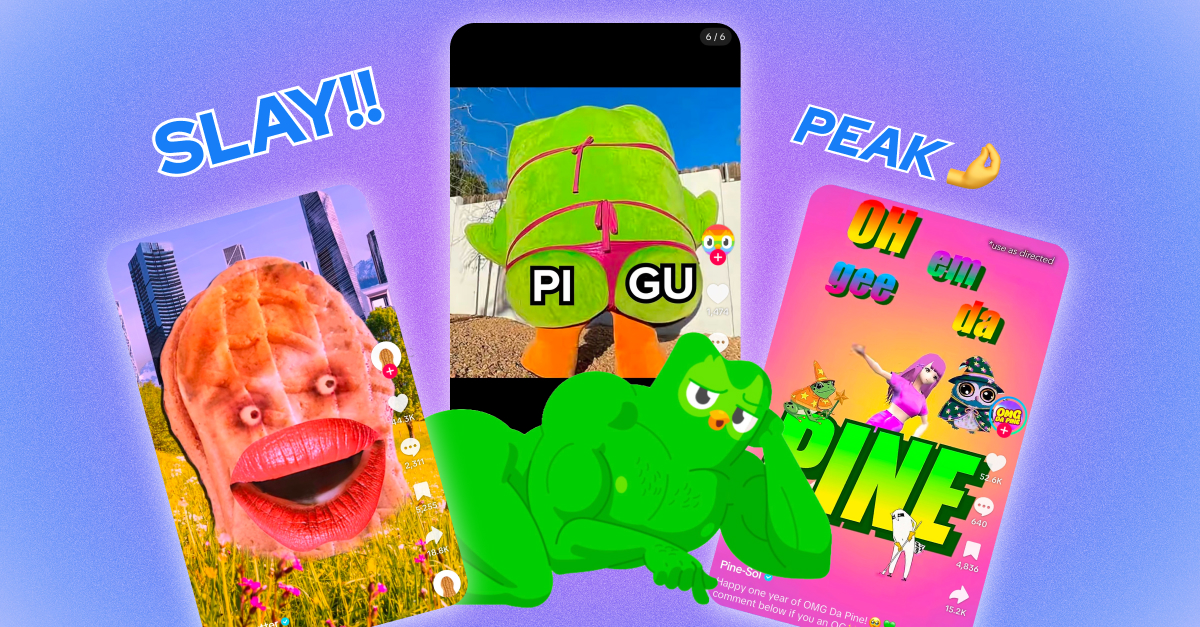
Pine-Sol made cleaning content weirdly watchable
Pine-Sol is a strong example because its unhinged approach still ties back to the product. Cleaning content already has built-in drama: the mess, the before and after, the satisfaction, the smell, the reveal. But Pine-Sol is still an everyday cleaning product, not something people usually treat as aspirational or exciting.
That's what makes the strategy interesting. Pine-Sol throws out the CPG product marketing playbook and opts instead for something more entertaining and off-the-wall.
Its TikTok presence leans into absurd, low-fi, and highly specific content that feels more like social entertainment than traditional household cleaner marketing. DTC Newsletter reported that Pine-Sol doubled its TikTok following in one month by using absurdist humor, original sounds, and lo-fi episodic content.
The content may look off the rails, but the strategy is tight. Pine-Sol uses recurring themes like “Pine-Solve this” to make the account feel episodic. That gives viewers a reason to keep watching, recognize the format, and follow along for more.
The risk: Absurdity can become the whole idea. Pine-Sol avoids that when the content still gives people a reason to associate the brand with a recognizable cleaning moment.
What makes it successful: It turns a functional product into a social character without abandoning the category.
KFC klnows exactly how strange it’s aAllowed to be
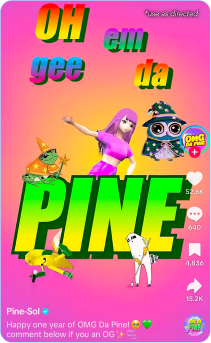
KFC has always had room to be a little unconventional. The Colonel is already a mascot with built-in theatrical energy. Fried chicken is indulgent, sensory, and easy to exaggerate. That gives KFC more room to play than a brand starting from a very serious baseline.
Its unhinged content works best when the joke is rooted in appetite, obsession, or the cultural eccentricity surrounding fast food fandom. KFC has used outrageous marketing ideas, including unexpected product plays and social-first jokes, to keep the brand in conversations where fast food, fandom, and absurdity overlap.
That’s the sweet spot for a food brand with a bold product identity. The content can be outrageous because the product is already memorable.
The risk: Food humor can turn people off quickly. If the unusualness makes the product feel unappetizing, the brand may win attention while weakening desire.
What makes it successful: KFC’s strongest unhinged ideas make the brand feel culturally fluent without making the food feel like the punchline.
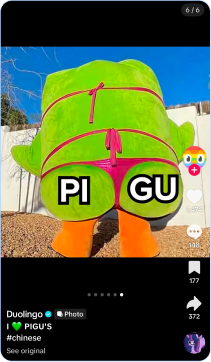
Duolingo turned pushy reminders into a personality
Duolingo is the blueprint many marketers think of when they hear unhinged marketing.
Duolingo's unhinged behavior became the template for many brands because it turned product feedback into a character-driven social universe. The brand took Duo the Owl from a mascot to a social character with jealousy, menace, drama, and a strangely lovable personality.
The content worked because it expanded something users already knew about the product: Duolingo reminders can feel intense. Instead of hiding that perception, the brand amplified it.
That’s why the account became so memorable. The owl wasn’t random. The joke came from a real product truth. Then the brand built a repeatable entertainment system around it.
Not every brand needs a chaotic mascot. The lesson here is that a strong social character can create continuity across posts, platforms, and campaigns.
The risk: Fatigue. When a character becomes famous for chaos, the audience eventually expects escalation. That can make the brand harder to manage over time.
What makes it successful: Duolingo’s unhinged voice came from a real product truth, then grew into a repeatable entertainment engine.
Ryanair roasts itself before travelers can
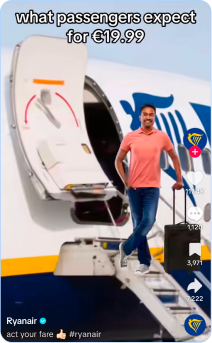
Ryanair’s unhinged marketing works because it’s brutally self-aware.
The airline doesn’t try to sound premium. It doesn’t pretend low-cost travel is glamorous. Instead, Ryanair uses TikTok to make jokes about the exact things travelers already associate with budget flights: fees, cramped seats, strict bag requirements, blunt service, and chaotic travel expectations.
That honesty gives the humor credibility. Ryanair isn’t suddenly acting chaotic because TikTok likes chaos. The brand has always had a sharp, low-cost, no-frills personality. TikTok just gave that voice a better stage.
The risk: Self-roasting can reinforce negative perceptions if it isn’t balanced by operational value. The jokes work because the audience already understands the tradeoff: cheap flights come with compromises.
What makes it successful: Ryanair’s humor fits the business model.
Nutter Butter committed to the bit until the bit became the brand
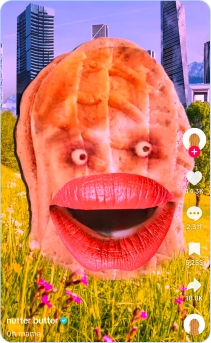
Nutter Butter might be the most unhinged of them all. The brand’s social channels are the clearest examples of a brand going full surreal.
Its TikTok content often feels like a snack brand wandered into a horror meme, a feral dream sequence, and an inside joke all at the same time. It uses recurring characters, distorted visuals, bizarre audio, and a sense of mystery or is it confusion? Whatever the case, it encourages people to comment because they’re trying to understand what they just watched.
The success comes from commitment. Nutter Butter doesn’t dabble in the peculiar. It builds a world around it; it becomes it.
That’s also the risk. Surreal content can be polarizing. Some people will love it. Some will find it irritating. Some will have no idea what’s happening.
For Nutter Butter, that confusion appears to be part of the appeal. The brand is selling a nostalgic cookie in a category where distinctiveness matters. Being strange gives people a reason to remember it.
What makes it successful: Nutter Butter made its oddness consistent enough to become brand equity.
What these brands got right
These brands didn’t all use the same formula, and that’s the point.
Pine-Sol found the eccentric in cleaning culture. KFC leaned into food obsession. Duolingo built a character from a product truth. Ryanair turned customer complaints into self-aware entertainment. Nutter Butter committed to surreal world-building.
The strongest unhinged marketing examples are not random acts of outrageous marketing. They’re repeatable creative systems. Each brand knows what kind of joke belongs to them, what kind of risk their audience will accept, and what kind of content can keep showing up without feeling stale.
The best examples have four things in common:
- The tone fits the brand.
- The platform shapes the creative.
- The content gives people a reason to respond.
- The weirdness is repeatable.
The last point matters the most. One strange post can get views, but a distinct voice can build memory.
When Cringe Marketing Backfires
Cringe marketing usually backfires when a brand confuses attention with permission. A post can get people talking and still damage trust if the joke feels careless, forced, or disconnected from what the audience expects.
That’s the difference between a calculated risk and a preventable miss. Strong unhinged marketing has context, timing, and a clear reason to exist. Cringe marketing often skips those steps and hopes the reaction will be enough.
When shock travels faster than context
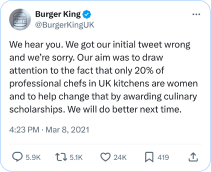
Burger King’s 2021 International Women’s Day X post from its UK account is one of the clearest examples of a risky joke collapsing under its own setup.
The post opened with “Women belong in the kitchen,” before follow-up posts explained the brand was promoting a scholarship program for women in culinary careers. The first line traveled faster than the context. Burger King deleted the tweet and apologized after backlash.
This is the danger of relying on shock before clarity. The campaign had a real message underneath it, but the format created the wrong first impression. On social, many people will see one post, one screenshot, or one quote without the surrounding explanation.
When edgy starts to feel forced
Cringe marketing usually follows a familiar pattern. A brand uses slang after the internet has already moved on. It jumps into a meme without understanding the context. It weighs in on a cultural moment with no real reason to be there. Or it acts edgy in a way that feels completely disconnected from the product, audience, or brand voice.
The problem is not always the joke itself. It’s the mismatch. When the behavior feels borrowed, the audience can tell.
Trying too hard sounds like a brand asking to be let in on the joke. Strong, unhinged marketing feels like the brand created the joke.
When every brand is telling the same joke
A trend is probably stale when every brand account is using the same audio, format, caption structure, or joke setup. That doesn’t mean you can never use it. It just means the bar for relevance is higher. Before joining a trend, ask:
- Can we add something specific to this?
- Would our audience expect us to have a point of view here?
- Is this trend still moving, or are we posting the recap?
- Does this make sense without the trend attached?
If the answer is no, skip it. Trend participation should make the brand feel sharper. If it only makes the brand feel present, it’s probably too late.
Should Your Brand Try Unhinged Marketing?
Unhinged marketing is tempting because the upside is obvious. It can make a brand feel faster, funnier, and more culturally fluent. It can earn attention that polished content misses and give people a reason to talk about you.
But it’s not a shortcut to relevance. The brands that make it work have a clear sense of who they are, what their audience expects, and where the joke should stop. Before your brand goes unhinged, make sure the strategy can support the tone.
A brand-fit checklist
Before testing unhinged content, ask:
- Does our audience already use humor, memes, or irony when talking about our category?
- Do we have a clear brand voice that can stretch without breaking?
- Is there a product truth, customer behavior, or brand perception we can build from?
- Are we prepared for comments, confusion, and mixed reactions?
- Can we explain why this content makes sense for the brand?
- Do we have approval guardrails that allow speed without creating unnecessary risk?
- Can we measure success beyond views?
If you can’t answer these questions, the brand may need a clearer voice strategy before it needs chaotic content.
Industries where it can work faster
Unhinged marketing tends to work faster in categories where entertainment, identity, taste, or social conversation already shape buying decisions. That includes:
- Food and beverage.
- Beauty.
- Fashion.
- Retail.
- Travel.
- Entertainment.
- Consumer apps.
- Sports.
- Gaming.
- Lifestyle products.
These categories often have more cultural permission to play. They’re visual, social, and emotionally driven. They also tend to have audiences that enjoy brands acting more like creators.
Industries where trust and compliance should lead
Some industries can still use humor, but trust has to come first. That includes:
- Healthcare.
- Financial services.
- Insurance.
- Education.
- Government.
- Legal.
- Children’s products.
- Regulated industries.
- Media and publishing.
For these brands, “unhinged” may show up as light self-awareness, plainspoken education, or culturally fluent responses rather than full absurdity.
A bank doesn’t need to post like Nutter Butter. Instead of trying to be the most abnormal brand in the feed, focus on becoming the most memorable version of your own brand.

How To Test It Without Breaking the Brand
Testing unhinged marketing doesn’t mean giving up control of the brand. The goal is to create enough space for faster, more entertaining content while keeping the strategy clear and the risks manageable.
Start small, learn quickly, and pay close attention to how the audience responds. The best tests give teams room to experiment without making every post feel like a reputational risk.
Start with one channel and one format
Don’t overhaul your entire brand voice at once. Start with one channel where the audience already rewards experimentation. For many brands, that will be TikTok, Instagram Reels, or comments. Choose one repeatable format, such as:
- A recurring character.
- A self-aware response series.
- A lo-fi product joke.
- A trend filter with clear rules.
- A comment-led content series.
- A behind-the-scenes format with a sharper tone.
This gives the team room to learn without turning every channel into a test lab.
Use social listening and sentiment checks before scaling
Views can be misleading. A post can perform well because people love it, hate it, or cannot believe it exists. That’s why sentiment matters. Before scaling an unhinged content style, look at:
- Comment tone.
- Share context.
- Creator reactions.
- Brand mentions.
- Repeat engagement.
- Follower growth or loss.
- Customer questions.
- Negative themes that keep showing up.
Social listening helps teams understand whether the audience is laughing with the brand or at it. That distinction is especially important when testing humorous marketing, because positive engagement and negative engagement can look similar in a performance report.
Put guardrails around approvals, tone, and timing
Unhinged marketing needs guardrails more than safe content does. The team should know:
- What topics are off-limits.
- Which trends require legal or leadership review.
- How far the brand can go with sarcasm.
- When to respond in comments.
- When to delete, clarify, or pause.
- Who approves time-sensitive posts.
- What happens if the response turns negative.
Good guardrails won’t kill creativity, they’ll actually help the creative process move faster. Unhinged content should feel spontaneous to the audience, not unmanaged inside the business.
How To Measure Whether It Worked
Views are the easiest metric to celebrate and one of the easiest to overvalue. A post with millions of views can still miss the mark if the audience doesn’t remember the brand, trust the brand, or take any meaningful next step.
Measure unhinged marketing through a mix of attention, sentiment, and business signals.
Start with shares, saves, comments, and sentiment. Shares show cultural traction. Saves show utility or rewatch value. Comments show participation. Sentiment shows whether the attention is helping or hurting.
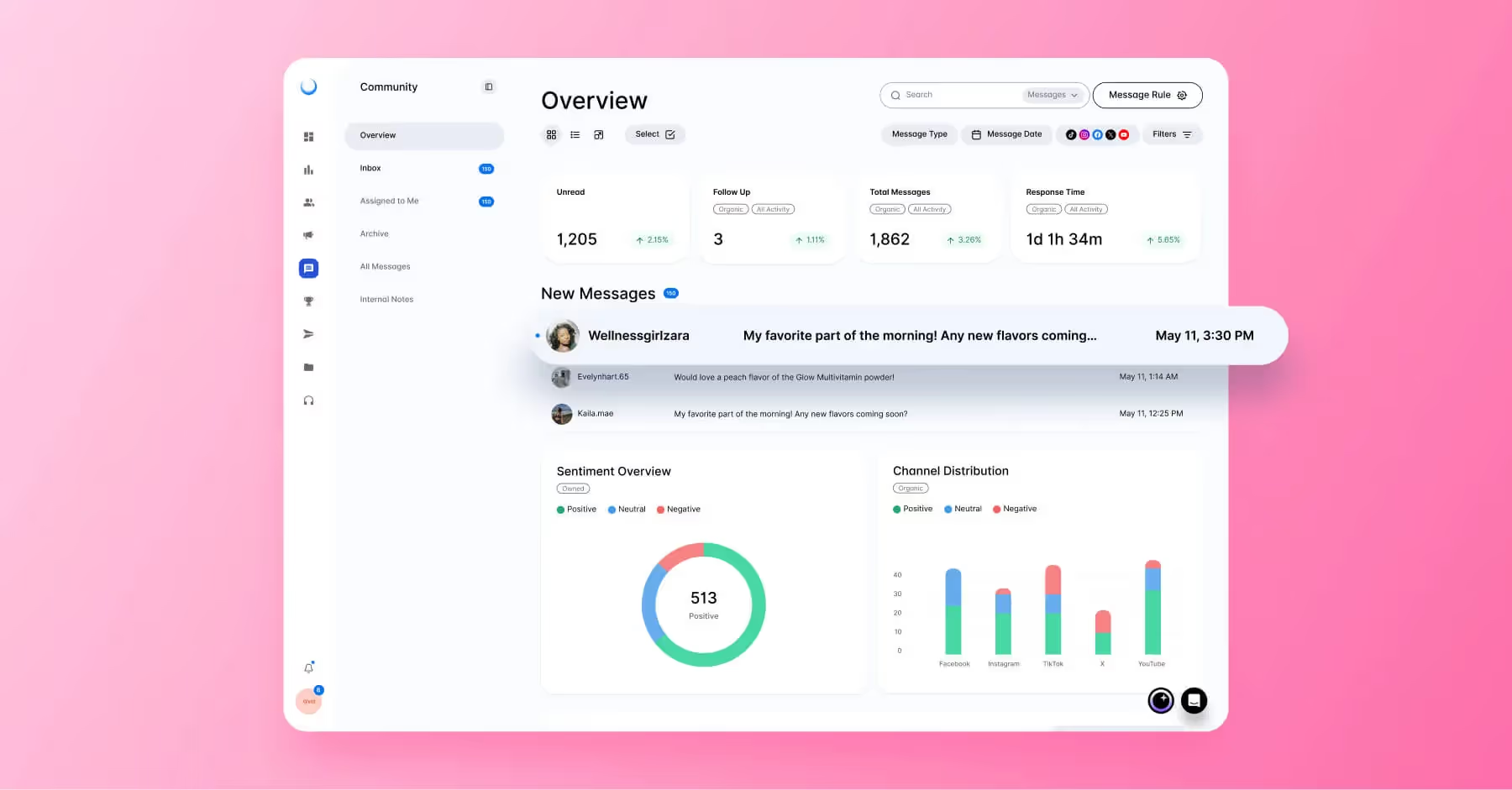
This is where brand-specific intelligence matters. Generic sentiment analysis can tell you whether a comment looks positive, negative, or neutral. Dash Social goes deeper by measuring sentiment through the lens of your brand’s unique identity, audience, and content history. The AI that powers Dash Social learns from your brand’s social world, so it can help you understand whether people are laughing with you, confused by you, or reacting in a way that could hurt trust.
That context is especially important for unhinged marketing. A sarcastic comment, inside joke, or chaotic comment thread might look risky without the right context. But for some brands, that kind of response can signal strong audience connection. Dash Social helps you read those signals more clearly, so you can tell the difference between attention that builds momentum and attention that creates risk.
Then look at brand search lift and referral traffic. If the content is working, more people may search for the brand, visit the profile, click through to the site, or look for the product. The point is to measure the job the content was meant to do.
Start with the goal. If you wanted awareness, look at recall and the quality of your reach. If you wanted engagement, look at who joined the conversation and how they felt about it. If you wanted conversion, connect the post to site traffic and the actions people took next.
Unhinged Marketing FAQs
Does unhinged marketing work?
Yes, unhinged marketing can work when it fits the brand, audience, product, and platform. It works best when the content is rooted in a real brand truth, not copied from another account’s tone.
Is cringe marketing effective?
Cringe marketing can earn attention, but attention alone isn’t the same as effectiveness. It may work if the cringe is intentional, self-aware, and audience-approved. It backfires when the brand feels out of touch, forced, or careless.
What metrics matter more than views when testing unhinged content?
Shares, saves, comments, sentiment, brand search lift, referral traffic, follower quality, conversion signals, and assisted pipeline are all more useful than views alone. Views tell you people saw it. The other metrics tell you whether it mattered.
Is unhinged marketing the same as cringe marketing?
No. Unhinged marketing is intentionally bold, strange, or chaotic in a way that fits the brand. Cringe marketing feels awkward, forced, or disconnected from the audience. The difference is often self-awareness.
What brands are known for unhinged marketing?
Duolingo, Ryanair, Nutter Butter, KFC, Wendy’s, and Pine-Sol are often cited as unhinged marketing examples. They’re also some of the funniest brands and weirdest brands on social because their content feels specific to their product, audience, and platform.
How do you know if a brand voice is going too far?
A brand voice is going too far when the audience reaction shifts from playful confusion to distrust, discomfort, or rejection. Watch for negative sentiment patterns, follower loss, confused customer comments, internal escalation, or content that gets attention while making the brand less credible.


.jpg)