10 Social Media Trends Shaping 2026
Social media trends help you stay proactive and prepared. Explore the 10 biggest shifts shaping 2026.

Social media is constantly evolving. With changing platforms, features, and trends, this means social media managers and their strategies must also evolve in order to reach their goals and keep up with industry shifts.
Dash Social analyzed various metrics and patterns to identify key shifts in the social media industry. One theme stood out: discovery and distribution are shifting. Moving away from volume (think filling up your content calendar ‘just because’) toward more intentional creative, a publishing cadence, and metrics that better reflect success.
Below are 10 social media trends identified through primary and secondary research, along with actionable takeaways for social media managers to help you refine your 2026 strategy and maximize the impact of your distribution efforts.
Key Takeaways:
- Strong, entertaining creative is essential as video views and discovery continue to surge.
- Growth is driven by feed recommendation, not follower counts. Prioritize reach and impressions.
- AI performs best when guided by clear brand standards and creative direction.
- UGC and creator content are expanding beyond social, driving major impact across platforms.
- Intentional posting, accessibility, and localization help brands maximize distribution and engagement.
10 Social Media Trends
In 2026, the only constant is change. These 10 trends outline changes in the social media marketing industry you should consider when planning your strategy this year. Marketers who stay on top of trends will turn their social channels into powerful brand awareness and conversion machines.
For deeper analysis, check out our Social Media Trends Report, published twice a year with the latest updates and emerging trends.
Here's how smart marketers will stay ahead and stand out in 2026.
1. Strong Creative Matters More Than Ever
Great creative assets and a strong visual brand identity have always been important, but the need for unique and entertaining content has never been more important. In 2026, brands should be even more deliberate and focused on refining visual identities, rethinking short-form video strategies, and doubling down on creative assets that drive meaningful marketing outcomes. This should all be done while establishing a clear, ownable look and feel.
Video views are spiking, up 20% on Instagram and 44% on TikTok in 2025 compared to 2024. More audiences are watching brand content than ever before, making it more important than ever to understand how your brand shows up visually across social media.
Leveraging the right TikTok sounds, developing a unique content series that keeps users hooked, and sharpening your visual brand identity are all strong points for brands looking to focus on crafting unique, entertaining content that audiences return to again and again.

2. Growth Lives Outside Your Follower Count
Follower count no longer defines growth. Audiences discover and engage with brands through recommendation feeds far more than follower-based ones, whether that’s TikTok’s FYP or Instagram’s Explore and Reels feeds.
TikTok FYP impressions jumped from 31% in 2023 to 58% by the end of 2025, while Instagram non-follower views grew from 30% in 2024 to 49% in 2025. People are engaging more and more with content they find relevant, regardless of whether they follow the account behind it.
That change should influence how brands measure success. If awareness is the goal, follower growth alone won’t tell the full story. Reach, views, and impressions offer a clearer signal of how content travels and resonates beyond an existing audience. The brands seeing the most impact are aligning KPIs with real outcomes, then building strategies that prioritize discoverability over chasing the follow button.

3. Creative AI Needs Brand Direction
AI has become a standard part of the marketer’s toolkit, but automation without direction shows itself fast. Audiences recognize when content feels generic or disconnected from a brand’s voice, with the strongest results coming from brand-aware AI marketing that supports creative decision-making instead of replacing it. When content is guided by performance signals and grounded in clear brand standards, it keeps the human feel while scaling smarter.
Dash Social’s Vision AI data reinforces this point. Content predicted to perform well consistently outpaces low-predicted posts, driving 77% more shares, 70% higher engagement rates, and 32% more video views. These gains show that AI works best when it’s used to identify what resonates, then paired with creative execution that feels intentional and on-brand.
Brands like Anthropologie embrace Vision to pinpoint the most impactful pieces of UGC to use, with their top-performing post earning 142% more engagement than their lowest-predicted content. By using Vision to identify and incorporate UGC in their social media content, they help build a sense of relatability among audiences who can picture their products in their closet and homes.

4. Social Isn’t One Size Fits All
Social platforms can serve different purposes and roles, and content doesn’t necessarily perform the same on each platform. While the urge to reshare one piece of content without customizing for each platform can be tempting, it’s important to understand where discovery, conversion, and meaningful engagement happen for your brand.
Total Social Impact (TSI), Dash Social’s proprietary metric, measures cross-channel performance to show which platforms drive the most overall impact. By understanding which platforms contribute the most to TSI, brands can focus their efforts where they’ll have the most influence.
Brooklinen is a great example of using TSI to hone in and develop what works. Pinterest accounts for 26% of its TSI, the largest share across platforms. By leveraging this insight, the team can make a clear case to internal stakeholders about where to invest, enabling smarter channel prioritization and strategy.
The takeaway: use impact-driven metrics to prioritize the right channels, lean into what works, and refine what doesn’t.

5. UGC and Creators Expand Role and Boost TSI
The strongest social content feels human, which is why UGC and creators continue to take on a bigger role in high-performing strategies. As audiences respond to content that feels personal and relatable, brands are leaning into creator-led posts to drive reach and TSI.
From November 2023 to November 2025, UGC’s share of content grew from 8.2% to 13.3%, largely driven by TikTok. Once led by Instagram, UGC performance has shifted as TikTok now contributes more UGC-driven TSI for a growing number of brands.
Trésemme shows how this plays out in practice. Its ‘TRESidents’ share everyday hair tips, helping TikTok UGC account for over half of the brand’s TSI. Paired with creator partnerships like Paige DeSorbo, the brand reaches niche audiences with content that feels natural and platform-fit.

6. Intentional Posting Brings More Impact
Brands are moving away from posting for volume and leaning into intentional content that drives bigger impact. Instead of filling content calendars with constant updates, leading teams focus on fewer, higher-quality posts built around clear goals like discovery, engagement, or brand storytelling.
In 2025, brands that posted six times or fewer per week saw stronger engagement than high-volume posters. A moderate cadence (fewer than six posts weekly) delivered a 13% higher engagement rate on Instagram and a 63% lift on TikTok.
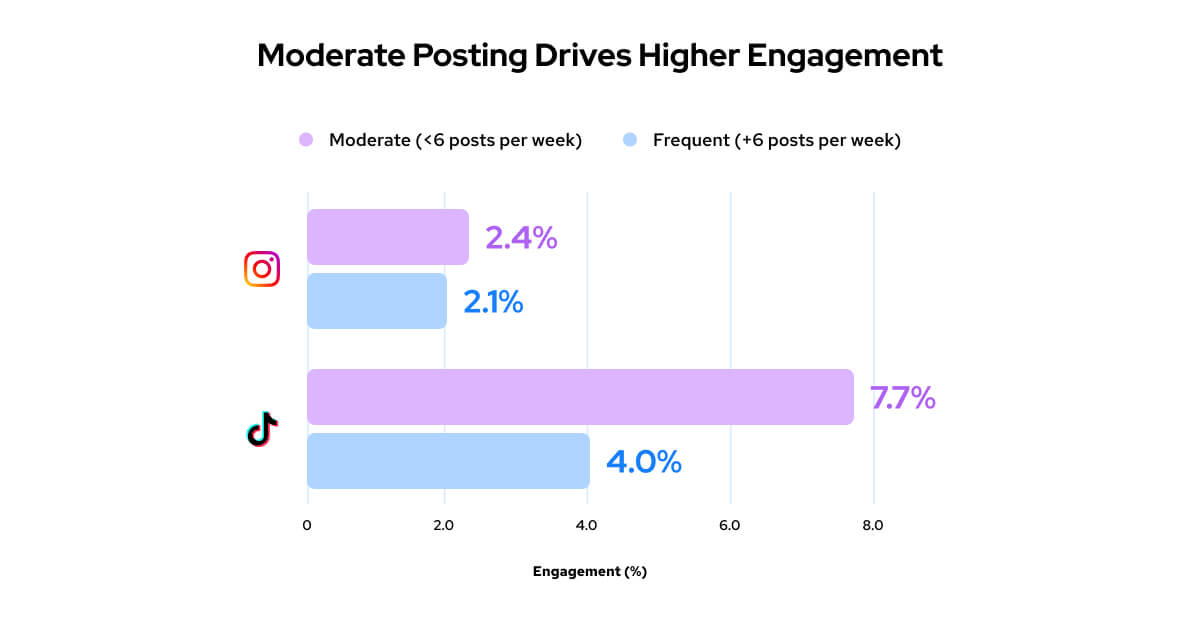
The takeaway: don’t ask “What are we posting today?” Ask “Why are we posting this?” to ensure every post earns its place.
7. The Best Brands Talk to Audiences, Not at Them
Top social teams are shifting away from one-way messages and making a concentrated effort to build rapport with audiences.
While social listening is nothing new to social media managers, 62% of marketers report that it’s their second-highest priority in 2025, just behind direct audience engagement. The two go hand in hand. By tracking signals like comments and mentions, and conducting regular sentiment analysis, brands gain valuable context into what audiences care about, what frustrates them, and what motivates them to take action. These insights lead to more meaningful conversations and help build community.
For brands, make the comment section a priority. Ask follow-up questions, pin thoughtful replies, and even turn strong comments into content. This can be done through a Stitch on TikTok that furthers a conversation or a new post on your Instagram Feed.
8. Accessibility Equalizes Social Content
In 2026, social media accessibility isn’t optional; it’s necessary. Prioritizing accessibility opens your brand to audiences who might otherwise be excluded and improves overall engagement.
Features like alt text, closed captions, and transcripts for videos also boost discoverability. Because captions, alt text, and transcripts can be indexed, they give algorithms more context about your content, helping platforms surface it to the right audiences.
The takeaway: add captions, write descriptive alt text, and design with contrast in mind to reach wider audiences and improve how platforms understand and distribute your content.
9. Localization Boosts Global Reach
Localization goes beyond simple translation. Localization means adapting tone, visuals, cultural references, and even platform strategy to fit where your audience lives and how they communicate. Tailored social content that reflects local language, norms, and preferences tends to deepen engagement and build trust faster than a one-size-fits-all global post.
This matters because when users feel a message speaks directly to them, they’re more likely to interact, share, and convert. While localization can be tough for global brands, it’s important to focus on scalability and incorporate either global or local social media handles to suit your audience.
As a bonus, localization can strengthen your social media SEO by making it easier for audiences to find your brand across platforms. Adapt your tone, visuals, and posting strategy by region (like understanding the best time to post on TikTok globally), and use local or hybrid handles when appropriate.
10. Collaborations Hit Feeds and Shelves
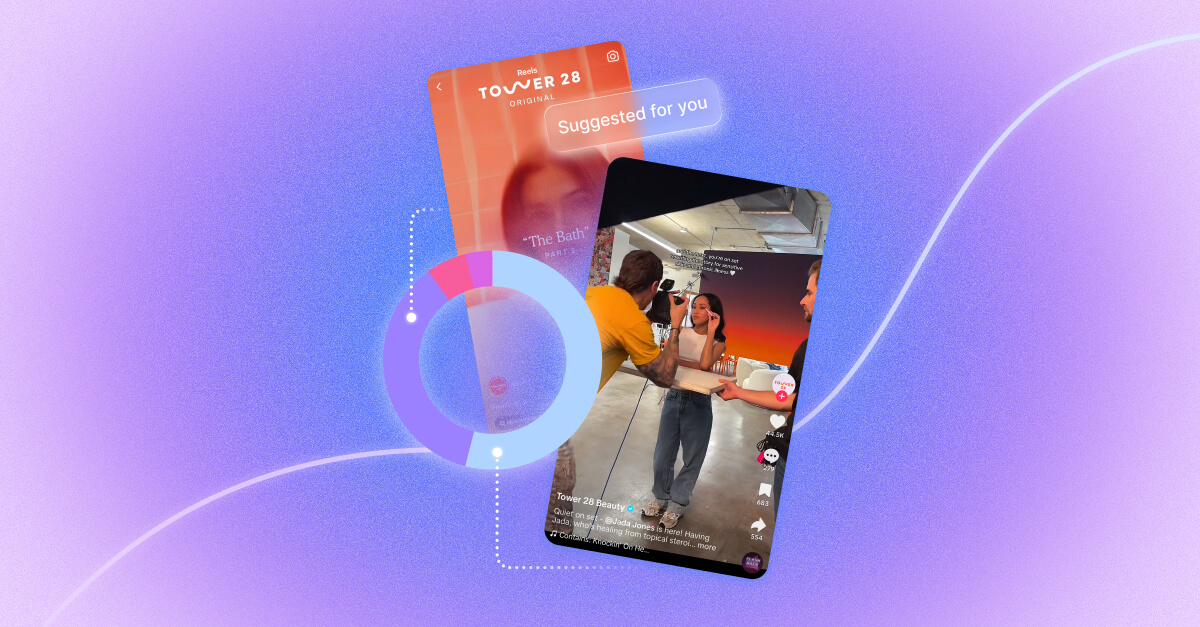
In 2026, creator collaborations live beyond the follower feed. Take beauty brand Tower 28, for example. In 2025, they launched their first product collaboration with content creator and blush expert Toni Bravo, releasing two limited-edition shades of their long-lasting blush.
Tower 28 also sees a major contribution from TikTok UGC, which accounts for 36% of its TSI. Reinforcing the value of bringing creator partnerships beyond social and onto store shelves. For brands, pay attention to what drives the biggest share of your TSI. If UGC leads the charge, explore new ways to integrate creators across your broader social and marketing strategy.


Learn the New Rules of Social Discovery and Distribution
Social media is the place where culture, content, and commerce collide. By refining distribution, leaning into original, creative, and harnessing marketing AI tools to execute your content syndication with precision. To dive even deeper into these trends and how to put †hem into action, explore Dash Social’s latest Social Media Trends Report.

Social Media Trend FAQs
What’s the best way to research social trends?
The best way to research social media trends is to combine reputable industry insights from leaders like Dash Social with active community engagement and real-time social listening. After all, every brand is different, and your audience is already giving you signals about what content they like best. This balanced approach helps you understand what's emerging and why, positioning your brand for ongoing relevance.
How do you track social trends?
You should use analytics to stay ahead of social trends, but be sure to also dive deep into community conversations and user-generated content to understand what the next trend is going to be. Continuous monitoring and active engagement ensure you're always prepared to respond to new trends quickly and effectively.
Where can I access historical trend data for social media?
To access historical trend data for social media, brands can use platforms like Dash’s social listening, industry reports, and reference trending blog content to see what was trending in the past. You can also use Google Trends which is a free tool that provides historical organic search data, which often go hand in hand with what is and what was trending on social media.


.jpg)