The Complete Facebook Marketing Strategy Guide for Brands in 2026
How brands can use organic and paid strategies to drive engagement and growth on Facebook.
Contents

While new platforms continue to grab headlines, Facebook remains one of the most powerful players in social marketing. With millions of daily users across generations, interests, and life stages, Facebook offers brands unmatched scale and targeting potential. But success doesn’t come from posting and hoping for the best.
To really make Facebook work, brands need to understand how the algorithm prioritizes content, which formats drive action, and how organic and paid strategies work together. Whether you’re aiming to build awareness, grow a community, or drive traffic, the tools are there: you just need a smart Facebook marketing strategy to unlock them.
Key Takeaways:
- Facebook remains a powerful, full-funnel marketing channel when organic and paid strategies work together.
- Success on Facebook depends on understanding the algorithm and creating content that drives meaningful interaction.
- High-performing Facebook strategies blend multiple content formats, with a strong focus on video, community, and action-driven posts.
- Paid ads, retargeting, and precise audience building are essential for scaling growth and driving conversions.
- Measuring the right metrics and continuously optimizing with data-backed insights leads to stronger, more sustainable results.
What Is Facebook Marketing?
Facebook marketing uses a mix of organic content and paid social strategies to promote your brand, engage audiences, and drive measurable business outcomes.
Organic Facebook marketing focuses on building relationships through posts, comments, shares, Groups, and community interactions. Paid Facebook marketing uses Meta’s ad tools to distribute content to specific audiences based on demographics, interests, behaviors, and intent.
Together, these approaches balance growth, relevance, and performance, making Facebook a foundational channel in many multi-channel social strategies.
Why Is Facebook Marketing Important?
With over 197 million active users in the United States, Facebook offers one of the largest and most diverse audiences of any social platform. Its breadth of formats and tools also makes it uniquely suited to support a wide range of marketing goals, from building awareness to driving conversions and long-term loyalty.
Beyond the News Feed, brands can leverage Reels, Stories, Groups, Facebook Shops, Messenger, and Ads to create varied experiences across the funnel. This flexibility allows marketers to build community, distribute content at scale, and drive direct action. All within one ecosystem.
Some of the key benefits of Facebook marketing include:
- Build stronger customer relationships through comments, Groups, and Messenger.
- Support the full marketing funnel, from awareness to conversion and retention.
- Scale high-performing content easily with boosting and paid amplification.
- Gain actionable insights with robust analytics to optimize strategy over time.
How the Facebook Algorithm Works (and Why It Matters)
Facebook’s algorithm is designed to surface content that sparks meaningful interactions. Posts that generate comments, shares, saves, watch time, and clicks are far more likely to earn broader distribution in the feed.
Some of the key signals Facebook looks at include the quality of engagement (with comments carrying more weight than likes), video watch time and completion rates, click-through rate, posting timeliness and consistency, and how relevant the content is to a user’s interests.
For brands, this means publishing content designed to spark interaction, not just visibility.
How To Build Your Facebook Strategy in 6 Steps
There are many ways to build a Facebook strategy, all of which depend on your broader marketing goals and how they relate to your social media strategy. Here are the basics to build a Facebook strategy.
1. Set SMART Goals
Before posting or running ads, outline what you want to achieve. SMART goals are specific, measurable, achievable, relevant, and timely. Instead of vague goals like ‘increase engagement’, a related SMART goal would be “increase post shares by 15% over the next quarter.” Setting goals helps you track progress and prove the impact of your work.
2. Dive Into Audience Analytics
Understanding who engages with your content is essential. Facebook’s built-in social media analytics provide insights into demographics, behaviors, and activity times. By studying this data, you can tailor your strategy to meet your audience’s preferences. For example, if you notice your target audience converts better on straightforward product posts, you’ll know it’s a good idea to incorporate product posts whenever possible in your Facebook campaigns.
3. Take Advantage of Free Tools
Facebook offers a wide range of free tools designed to support marketers. Business Suite, Page Insights, and social media scheduling tools help streamline content creation, publishing workflows, and help your team track and measure various social media KPIs. Consistently using these tools ensures you’re crafting your strategy and making decisions based on real-time performance, not speculation.
4. Create Content That Drives Action
Content sits at the core of Facebook marketing. Successful brands blend educational, entertaining, and promotional content across formats like video, carousels, Stories, and link posts. Testing multiple formats helps identify what resonates most with your audience.
5. Increase Visibility With Paid Ads
Facebook’s targeting tools allow brands to reach new audiences, retarget engaged users, and test creative with flexible budgets. Perhaps the best part of Facebook marketing is the ability to boost a Facebook post with any budget. Boosting top-performing organic posts is often a smart, low-risk entry point.
6. Measure, Test, and Optimize
Marketing on Facebook isn’t a ‘set it and forget it’ effort. It’s important to regularly review analytics to see what’s working and where adjustments are needed. Look at metrics like viewers, engagement, and conversions to assess success. Use these insights to refine your strategy, test new approaches, and continuously improve results over time.
While native analytics are useful, third-party social media analytics tools provide deeper insights, cross-channel comparisons, and automated reporting.

Be First To Know What Comes Next
Dash’s Social Media Trends Report helps sharpen your strategy on social with data-backed insights and trends derived from the world’s best brands.
Get the 2026 Social Media Trends ReportFacebook Marketing Tips To Maximize Impact
Facebook remains one of the most effective platforms for connecting with audiences, but getting results requires more than posting at random. With the right tactics, brands can boost engagement, reach new customers, and enhance customer loyalty. Below are practical tips to help you refine your approach and maximize impact.
Use a Mix of Content Formats
Using a mix of content formats lets you understand what resonates best with your audience, while making the most of the different posting options available on Facebook, like Stories, video, blog links, and more. Be sure to use the right social media image size for a Facebook post to ensure your visuals pack a punch.
Prioritize Accessibility With Alt Text
Incorporating alt text into your content isn’t just important for social media accessibility; it also helps your brand become easier to discover within the Facebook algorithm. Well-written alt text tells the algorithm more about your content and ultimately what your brand is all about, plus, it makes your content and brand more inclusive to all audiences.
Post Consistently, Not Constantly
Maintaining a posting schedule is important, but for the best results, it shouldn’t be sporadic or inconsistent. With platforms like Dash Social, you can find your best time to post on Facebook based on past historical performance, so you know that you’re posting at the optimal time for your audience.
Use Facebook Groups To Develop Community
Facebook Groups are one of the most powerful tools for cultivating an authentic community. Unlike regular posts, Groups invite members to participate, share their own stories, and engage with one another. Whether you’re offering support, organizing events, or facilitating peer discussions, a Group gives your audience a sense of belonging and connection.
Leverage Retargeting
Retargeting turns interest into action. By showing ads to people who’ve already interacted with your page, video, or website, you stay on their radar with messages that matter. It’s a smart, cost-effective strategy. For instance, someone who skipped your shopping cart yesterday may be ready to complete a purchase today if you offer a timely reminder, an incentive, or even a discount code. Retargeting brings back prospects and moves them closer to conversion without wasting effort on cold audiences.
Track Metrics That Matter
Not all metrics are created equal. Instead of chasing vanity metrics that aren’t applicable to your goals, focus on those that say something meaningful, like engagement rate, click-through rate, or cost per result. These metrics show how content is actually performing with your audience and how well it contributes to your goals. Aligning your tracking to your objectives ensures you’re making decisions based on results, not assumptions. And that keeps your strategy grounded and accountable.
Stay Ahead of Platform Trends
Facebook continues to evolve toward discovery and entertainment content. To keep your strategy sharp, combine trend reports with real-time listening and analytics. That way, you can spot shifts early, like a spike in Reel performance, a surge in messaging behavior, or a new interactive feature, and respond fast to what resonates.
Facebook Marketing Examples
Sometimes the best way to understand what works on Facebook is to see it in action. Here are some examples of how brands market on Facebook and set themselves apart.
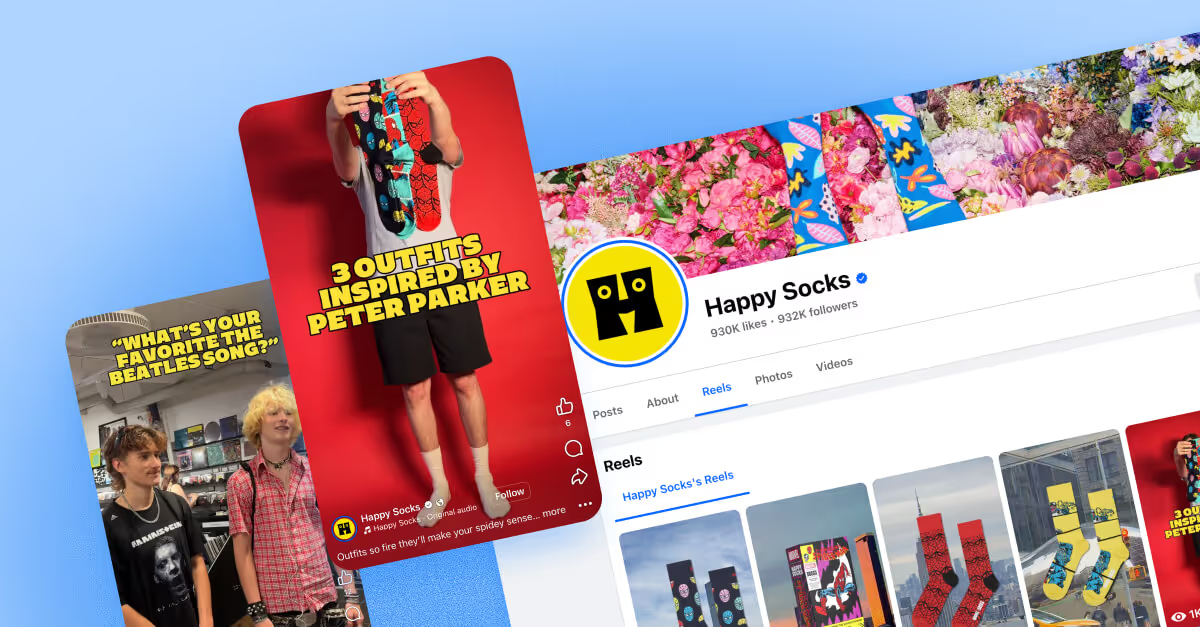
Happy Socks
Happy Socks leans fully into its bold, colorful brand identity on Facebook. The brand frequently shares vibrant visuals, creative videos, and trendy Reels that feel joyful, playful, and instantly recognizable. A prominent ‘Shop Now’ button on their profile directs users to a custom landing page, making it easy to track traffic and conversions driven by Facebook.
The brand also partners with artists, pop culture icons, and charitable organizations, from Spider-Man to The Beatles and WWF, keeping its content culturally relevant and highly shareable.
Strategy takeaway:
- Uses strong visual branding and collaborations to drive awareness, while pairing organic content with clear conversion paths.

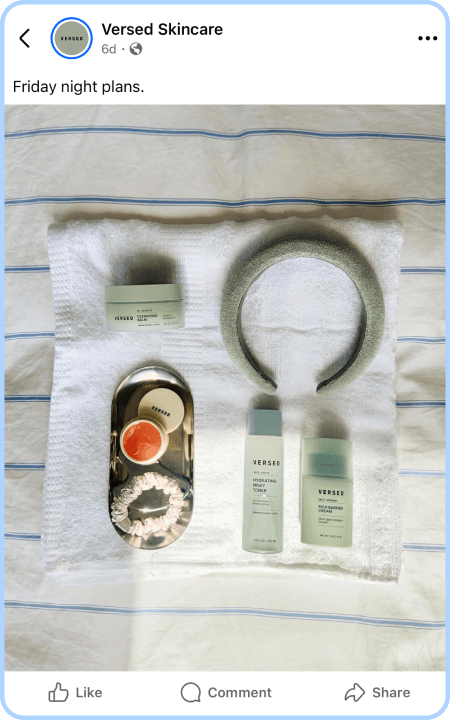
Versed Skincare
Versed takes a more understated, educational approach on Facebook, using muted tones and clean visuals to reflect its brand values. The brand mixes skincare tips, inspirational messaging, and light humor in mostly static posts, creating a feed that feels informative without being overly promotional.
By weaving real-life skincare moments into product content, Versed builds trust and relatability, positioning itself as both a clean beauty authority and an approachable, everyday brand.
Strategy takeaway:
- Balances education and product storytelling to build credibility and long-term engagement.
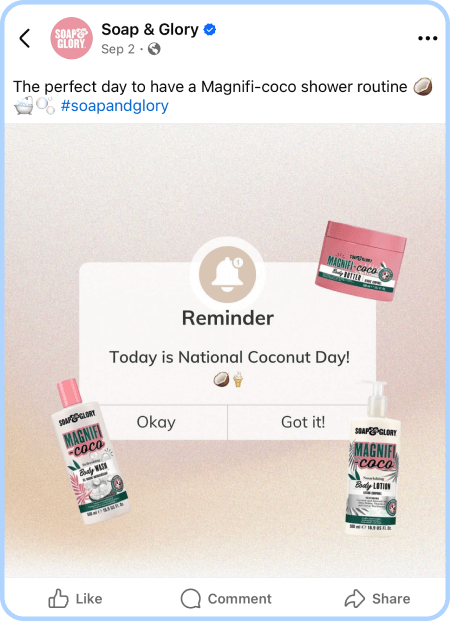
Soap and Glory
Soap & Glory brings a playful, tongue-in-cheek tone to its Facebook presence. The brand leans into bold product names, soft-pink visuals, and offbeat humor, creating content that feels fun and personality-driven. Their feed highlights a mix of UGC, trend-led posts, and campaign content designed to spark participation and conversation.
This consistent voice makes the brand instantly recognizable and encourages audiences to engage, share, and join in on the fun.
Strategy takeaway:
- Uses humor, UGC, and brand voice to drive engagement and foster community.
How Dash Social Supports Facebook Marketing Strategy
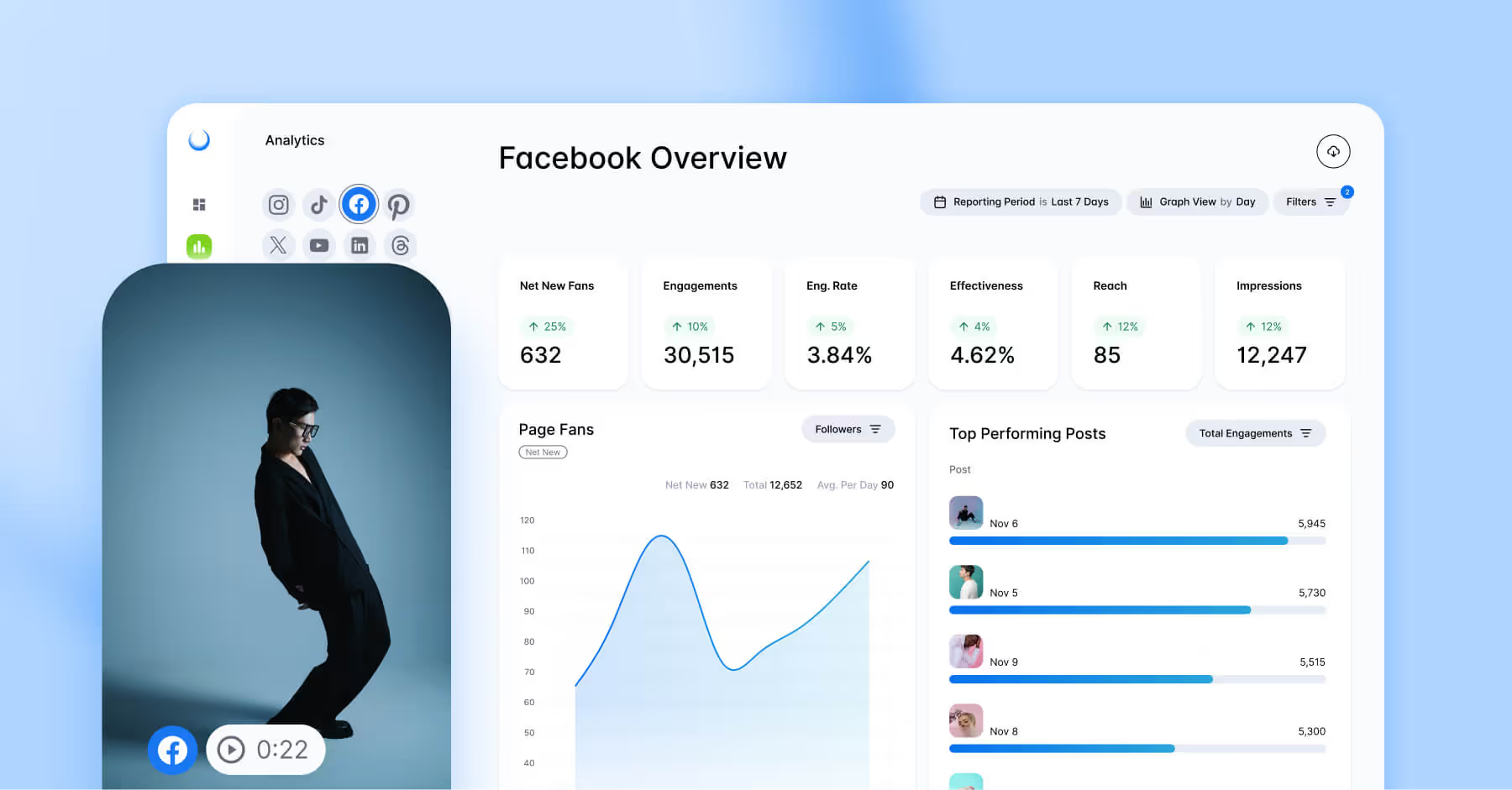
Dash Social helps brands go beyond native analytics by providing deeper Facebook Insights, customizable reporting, and cross-channel performance measurement. With Dash Social, teams can identify top-performing content, benchmark results, and make smarter, faster decisions that drive real impact.
Facebook Marketing Strategy FAQs
How can I use Facebook groups for marketing?
Facebook Groups are designed for connection, not direct selling, but they can still play a powerful role in your marketing strategy. By creating or participating in Groups, you position your brand as a trusted resource within a community. Use Groups to share exclusive content, answer questions, and gather feedback from members. Over time, this builds credibility and loyalty, which can indirectly drive sales and strengthen customer relationships.
Is organic reach dead on Facebook?
Organic reach isn’t dead on Facebook, but the way it's measured has evolved. Meta now uses Viewers instead of Reach to measure unique people who see your content. While organic visibility can be challenging, brands can still drive results with engaging content that encourages comments, shares and meaningful interactions.
Can I manage Facebook, Instagram, and Messenger ads from one place?
Yes. Meta Business Suite (previously known as Facebook Business Manager) lets you manage ads across Facebook, Instagram, and Messenger in one centralized platform. From there, you can create campaigns, set budgets, and track performance across channels without having to juggle multiple dashboards. This saves time and helps keep your campaigns consistent and easier to optimize.
What’s Audience Building and why does it matter?
Audience building on Facebook refers to the process of identifying and nurturing groups of people most likely to engage with your brand. This includes custom audiences made from website visitors, lookalike audiences based on existing customers, and interest-based audiences. It matters because the more precisely you define and grow your audience, the more effective your content and ads become. A well-built audience helps reduce wasted spend and ensures your message meets the right people.
Is Facebook still effective for lead generation, especially in niche industries?
Yes, Facebook remains a strong channel for lead generation, even in niche markets. The platform’s advanced targeting allows you to reach specific demographics, industries, and interest groups that align with your business. Lead forms, Messenger interactions, and call-to-action buttons make it easy to capture information directly on the platform. For niche industries, this precision ensures that your campaigns are reaching qualified prospects, often at a lower cost compared to broader channels.


.avif)
.avif)