Digital Marketing Glossary
Creative Intelligence
Creating great social content is no longer just about creativity; it’s about truly understanding what’s really driving results. Creative intelligence combines AI, creative analytics, and social media performance data to help brands identify the visuals, messaging, formats, and creators that resonate the most with their audience.
By turning creative performance into actionable insights, brands can make smarter content decisions, improve campaign ROI, strengthen brand consistency, and build a more effective social media strategy that your audience remembers over time.
What Is Creative Intelligence?
Creative intelligence is the process of analyzing your brand’s creative assets to understand what drives engagement, reach, conversions, and other business outcomes.
Instead of relying on instinct alone, creative intelligence uses performance data and AI to identify the creative elements that consistently perform well with your audience and answer questions like:
- Which creative formats perform best with our target audience? Or with non-followers?
- What visual styles, colors, and hooks drive the most engagement time and time again?
- Which creators or influencers generate the highest ROI? Does audience size have an impact?
- What messaging themes lead to more clicks, shares, and conversions? Informative? Casual? Professional?
- How should future content be optimized based on our past campaign performance?
Unlike traditional social media analytics, creative intelligence explains why content performs well by uncovering patterns within the creative itself, helping marketers scale their strategies with greater confidence.
Creative intelligence vs. creative analytics
Creative intelligence and creative analytics are closely related, but they ultimately serve different purposes.
Creative analytics focuses on measuring how well (or poorly) creative assets perform. It answers “what happened” by tracking metrics for individual posts, ads, or campaigns.
Creative intelligence goes a step further by interpreting that performance to uncover “why it happened” and “what to do next”. It combines creative analytics with AI, pattern recognition, audience insights, and competitive context to identify the creative elements that consistently drive results and recommend ways to future content.
Think of it this way: creative analytics provides the data, while creative intelligence turns that data into an actionable creative strategy.
Why Understanding and Leveraging Creative Intelligence is Important
Understanding and leveraging creative intelligence helps teams move beyond guessing what will land with their audience to knowing by identifying the creative elements that consistently drive engagement, conversions, and brand affinity. With it, you can make faster, more confident content decisions backed by data.
Creative intelligence transforms content performance into a competitive advantage. Rather than simply reporting on what happened, it empowers social media managers to understand why content succeeds and applies those principles to create more effective campaigns, strengthen brand consistency, and achieve better business outcomes over time.
Benefits of Creative Intelligence for Social Teams
Creative intelligence helps social teams create more effective content by turning creative performance data into actionable insights. Instead of relying on isolated campaign results, teams can use their newfound intelligence to make faster decisions, improve content quality, and align creative efforts with broader goals.
Faster creative decisions
As we’ve already touched on, creative intelligence eliminates much of the guesswork from content planning. By surfacing patterns in what resonates with your audience, you can quickly decide which formats, messaging, visuals, or creators to prioritize, rather than testing everything from scratch.
Better content performance
Understanding which creative elements consistently drive results allows teams to optimize every post before it’s even published. Over time, these data-backed decisions lead to stronger campaign performance and higher ROI across both organic and paid social channels.
Stronger brand consistency
With the right creative intelligence, brands can identify the approaches that perform best while still reinforcing brand identity. This ensures that content remains recognizable and consistent across platforms, campaigns, and teams without sacrificing creativity.
More efficient creative production
Rather than creating content through trial and error, creative teams can focus on concepts with the highest likelihood of success. This reduces unnecessary revisions, speeds up content production, and helps teams produce more high-performing assets with the same results.
Better collaboration between teams
Creative intelligence gives designers, content creators, social media managers, and performance marketers a shared view of what drives results. Instead of debating opinions, teams can align around data-backed insights to refine creative strategies, optimize campaigns, and measure success using the same performance signals.
How Creative Intelligence Works
Creative intelligence transforms creative performance data into actionable insights by analyzing the content itself, not just the results it generates. Using AI tools and machine learning, it identifies patterns across your creative assets, connects those patterns to business outcomes, and recommends ways to improve future campaigns. Here’s how it works:
Creative asset analysis
The process begins by analyzing every creative asset you publish, including images, videos, captions, hashtags, audio, creators, and content formats. Rather than treating each post as an isolated piece of content, creative intelligence evaluates your entire content library to understand what characteristics contribute to success.
Visual and message tagging
AI then tags each asset based on its visual and messaging elements. Category groups may include identifying products, colors, people, settings, emotions, text overlays, calls to action, content themes, video styles, and caption topics. These tags create structured data that makes it possible to compare thousands of creative assets and uncover meaningful trends.
Performance pattern detection
Next, creative intelligence connects those creative attributes with performance metrics like engagement, reach, watch time, clicks, conversions, or revenue. Instead of simply reporting that a post performed well, it reveals which creative elements influence results.
For example, it may find that user-generated content, short-form videos with an attention-grabbing hook, or educational captions generate higher engagement for a particular audience.
Predictive creative recommendations
Once sufficient historical data has been analyzed, AI can recommend creative strategies likely to perform well in future campaigns. Example recommendations could suggest using a specific content format, emphasizing certain messaging themes, working with particular creator types, or adjusting video length based on what has historically driven the strongest outcomes.
Post-campaign learning and iteration
Creative intelligence doesn’t just stop when a campaign ends. Every post and campaign adds new data that refines and improves future recommendations. Teams can compare expected versus actual performance, identify emerging audience preferences, and continuously optimize their creative strategy. This ongoing feedback loop enables marketers to iterate faster, adapt to changing trends, and improve campaign performance over time.
How To Build a Creative Intelligence Workflow For Your Team
A successful creative intelligence workflow is built around continuous learning. Social teams should use every piece of content as an opportunity to gather insights, refine their strategy, and improve future creative decisions.
The goal is to create a repeatable process where performance data consistently informs your next move every single time.
1. Audit existing content performance
Start by reviewing your historical content across every social platform. Look beyond top-line metrics like impressions or follower growth and evaluate which posts consistently drive meaningful business outcomes, such as engagement, watch time, clicks, conversions, or revenue. Compare results across content formats, campaigns, creators, and audience segments to establish a performance baseline.
2. Identify repeatable creative patterns
Next, analyze your highest and lowest-performing content to uncover the creative elements that influence performance. Look for recurring themes in areas such as:
- Visual style and branding.
- Video length and editing style.
- Opening hooks.
- Messaging and tone of voice.
- Calls to action.
- Content formats.
- Creator or influencer characteristics.
What you’re looking to do is identify patterns that consistently contribute to success rather than focusing on one-off viral posts.
3. Create testable hypotheses
Turn your findings into measurable creative experiments. Instead of making broad assumptions, develop hypotheses that can be validated through future campaigns.
For example:
- Videos featuring people in the first three seconds will increase watch time.
- Educational carousel posts will generate more saves than promotional graphics.
- User-generated content will drive higher click-through rates than branded studio photography.
Start by testing only one variable at a time. Breaking up the analysis this way makes it easier to determine which creative elements truly influence performance.
4. Use AI to prioritize content ideas
As your creative library grows, AI can help identify the ideas with the greatest potential. By analyzing historical performance and audience behavior, creative intelligence platforms can recommend content formats, messaging themes, visual styles, publishing times, or creator partnerships that are most likely to succeed. Teams can then prioritize ideas that align with proven performance patterns while still leaving room for experimentation and innovation.
5. Measure, learn, and update creative guidelines
Creative intelligence is an ongoing process, not a one-time analysis. After every campaign, evaluate performance against your original hypotheses, identify new trends, and update your creative best practices accordingly.
As audience preferences, platform algorithms, and market conditions evolve, your creative guidelines should evolve with them. Document successful patterns, share insights across creative and marketing teams, and continuously refine your approach based on new data.
How To Measure Creative Intelligence Effectiveness
To properly measure creative intelligence, start by evaluating whether it helps your team make better creative decisions and achieve stronger business results over time. Not just whether individual posts perform well.
- Track content performance: Monitor improvements in engagement, reach, watch time, CTR, conversions, revenue, or ROAS after applying creative insights.
- Measure recommendation accuracy: Compare AI predictions and creative recommendations against actual campaign performance to see how reliably they identify winning content.
- Evaluate creative testing: Track how quickly your team identifies winning creative concepts, how many experiments produce actionable insights, and how often successful ideas can be scaled.
- Monitor production efficiency: Measure time spent planning campaigns, content production speed, revision cycles, and overall creative output to determine if insights are actually streamlining workflows.
- Assess brand consistency: Ensure high-performing content also aligns with your brand’s visual identity, messaging, and tone across channels.
- Connect creative to business outcomes: Measure the impact on goals like brand awareness, website traffic, lead generation, customer acquisition, sales, and ROI.
- Track team adoption: Evaluate whether creative and performance teams are using shared insights, updating creative briefs, and making faster, data-driven decisions.
- Continuously refine your strategy: Regularly review results, validate creative patterns, and update your creative guidelines as audience preferences and platform trends evolve.
Creative Intelligence Platform Features To Look For
When evaluating a creative intelligence platform, look for features that do more than simply report on performance. The best solutions combine AI, creative analysis, and social media analytics to help teams understand why content succeeds and how to improve future campaigns.
AI-powered creative analysis
AI should automatically analyze your creative assets to identify the characteristics that influence performance. Look for a platform that covers patterns in visuals, messaging, formats, and creators to reveal what resonates most with your audience.
Visual intelligence
Visual intelligence uses AI to recognize and categorize the elements within images and videos, such as products, people, colors, logos, settings, emotions, and text overlays. This makes it easy to identify which visual styles consistently drive engagement, conversions, or brand awareness across campaigns.
Predictive performance scoring
The best platforms don’t just analyze past performance; they help predict future success. Predictive scoring uses historical data and AI to estimate the likelihood that new creative assets will perform well, allowing teams to prioritize high-potential content before publishing.
Social media analytics integration
For creative intelligence to be at its best, it has to be connected to your social media analytics. Look for a platform that integrates engagement, reach, watch time, clicks, conversions, and other performance metrics across all major social networks to provide a complete view of how creative impacts business results.
Creator and campaign reporting
If your brand works with influencers or manages multiple campaigns, choose a platform that reports on creative performance at both the creator and campaign level. This helps identify which creators, partnerships, messaging themes, and campaign strategies deliver the strongest results and where to make future investments.
Dashboards and executive reporting
Creative insights should be easy to share across your organization. Customizable dashboards and executive-ready reports allow social teams to communicate creative performance, demonstrate ROI, and surface actionable insights for marketing leaders and stakeholders without requiring hours of manual reporting.
Together, the above features transform creative intelligence from a reporting tool into a strategic decision-making platform.
How Dash Social Supports Creative Intelligence
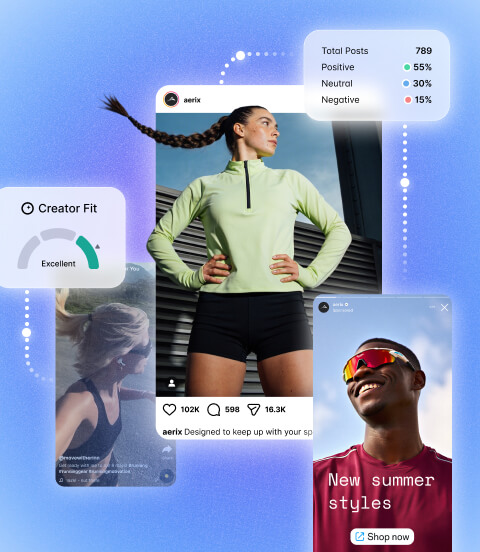
Dash Social helps brands put creative intelligence into practice by combining AI and automation with comprehensive social media analytics. Instead of simply reporting on engagement and reach, Dash Social analyzes content performance across channels to help teams understand which creative assets, formats, creators, and campaigns are driving the most meaningful business results.
With features like Generative AI and Predictive AI, Visual IQ, Campaign Reporting, Creator Management, Content Library, and customizable Reporting Dashboards, social teams can identify high-performing creative patterns, benchmark performance over time, and optimize future content with confidence.
By bringing creative insights, campaign analytics, and reporting together in one platform, Dash Social enables marketers to make faster creative decisions, improve collaboration across teams, and build a more data-driven content strategy.
COMING SOON: THE STATE OF CREATIVE AI REPORT
How AI Is Reshaping Creative Strategy, Brand Decision-Making, and Content Performance
Creative Intelligence FAQs
How can creative intelligence improve social media performance?

Creative intelligence improves social media performance by revealing which creative elements (like visuals, messaging, formats, creators, and hooks) drive engagement, reach, clicks, and conversions.
Turning performance data into actionable recommendations helps teams create higher-performing content, make creative decisions, and continuously optimize their strategy over time.
What is an example of creative intelligence?
A good example of creative intelligence is analyzing influencer campaigns to determine which creator characteristics, content styles, and messaging drive the highest engagement and conversions. Those insights can be used to select better partnerships, refine campaign briefs, and invest in collaborations more likely to deliver stronger results.
What should you look for in a creative intelligence platform?
When choosing a creative intelligence platform, look for features like AI-powered creative analysis, visual recognition, predictive performance insights, and integrations with your social media analytics. The best platforms also provide creator and campaign reporting, customizable dashboards, and actionable recommendations that help you create higher-performing content and demonstrate ROI.